Distinguishing Knowledge, Wisdom, and AI
In our rapidly evolving technological landscape, understanding the distinctions between knowledge, wisdom, and intelligence has become increasingly crucial. While artificial intelligence systems continue to advance at an unprecedented pace, these fundamental concepts remain at the heart of our discourse about machine capabilities and limitations.
Consider the classic tomato analogy: knowledge informs us that a tomato is botanically a fruit, wisdom guides us not to include it in a fruit salad, and intelligence enables us to comprehend this distinction without direct experience. This simple example illuminates the complex interplay between these three cognitive dimensions and their relevance to artificial intelligence development.
The DIKW Framework: A Scientific Perspective
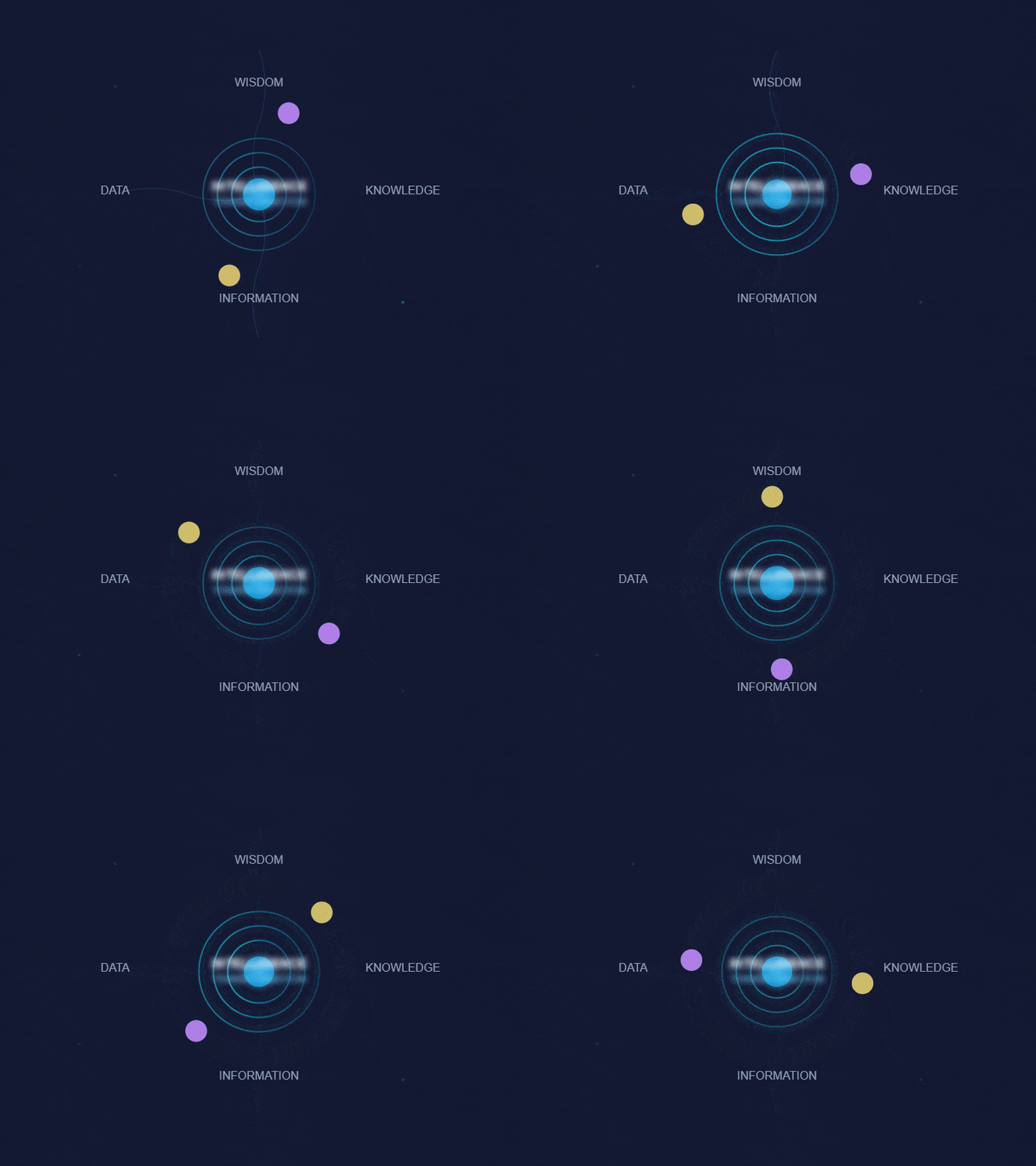
The Data-Information-Knowledge-Wisdom (DIKW) hierarchy provides a systematic framework for understanding how both human and artificial intelligence systems process information. Recent research in cognitive science and AI development has revealed the intricate relationships between these elements:
Data: The Foundation
Raw facts and figures form the base layer of cognitive processing. In AI systems, this manifests as vast datasets of unstructured information, ranging from text and images to numerical values.
Information: Contextual Understanding
When data is organised and given context, it transforms into information. Modern AI systems excel at this transformation, processing millions of data points to identify patterns and relationships.
Knowledge: Pattern Recognition
Knowledge emerges from the synthesis of information and experience. Current AI systems, particularly Large Language Models (LLMs), demonstrate remarkable capabilities in knowledge representation and pattern recognition across diverse domains.
Wisdom: Applied Understanding
Wisdom represents the highest level of cognitive processing, involving judgment, insight, and ethical considerations. This remains a significant challenge for current AI systems.
Current AI Systems: The Knowledge Paradigm
Today’s artificial intelligence systems, while impressive, fundamentally operate as sophisticated knowledge processors. Their capabilities include:
- Processing vast amounts of information at unprecedented speeds
- Generating content based on complex pattern recognition
- Applying learned knowledge within specific domains
- Making predictions based on historical data
However, these systems face fundamental limitations. They operate primarily through statistical pattern matching rather than genuine understanding, raising important questions about the nature of machine intelligence.
The AGI Horizon: Bridging the Intelligence Gap
Artificial General Intelligence (AGI) represents the next frontier in AI development. Unlike current systems, AGI would theoretically possess:
- Genuine comprehension of context and meaning
- Cross-domain reasoning capabilities
- Efficient learning from limited data
- True adaptability to novel situations
The Wisdom Challenge
Perhaps the most significant gap in current AI capabilities lies in the domain of wisdom. While AI systems can access and process vast amounts of human wisdom through their training data, they lack:
- Genuine causal understanding
- Original insight generation
- Authentic emotional intelligence
- Contextual awareness beyond pattern matching
Future Implications
As we continue to advance AI technology, understanding these distinctions becomes increasingly important for:
- Research and development
- Ensuring responsible AI deployment
- Setting realistic expectations
- Maintaining ethical considerations
Conclusion
The journey from current AI systems to true machine intelligence mirrors the progression from knowledge to wisdom in human cognition. While today’s AI demonstrates remarkable capabilities in knowledge processing and application, achieving genuine machine intelligence — with its accompanying wisdom and understanding — remains a complex challenge for future development.