Introduction
I've spent the last three months testing every GPT variant I could get my hands on, from the August GPT-5 release to this week’s GPT-5.2 drop. Like many AI leaders in London, I started this year believing Sam Altman's AGI predictions might have merit. I was wrong. The benchmark data tells a different story-one of impressive incremental gains that still leave true human-like intelligence as distant as ever.
The numbers don't lie, even when marketing teams spin them. OpenAI's latest models are undeniably powerful, but they're pattern-matching engines that stumble the moment genuine reasoning is required. For UK AI leaders building production systems, understanding this gap isn’t academic-it’s the difference between deploying reliable tools and creating expensive liabilities.
Background: Why AGI Remains a Mirage
AGI isn’t just another benchmark to beat-it’s the ability to handle any cognitive task a human can, with the same flexibility and common sense. OpenAI's stepwise ascent from GPT-2 to GPT-5.2 shows remarkable progress in specific domains, but the path to AGI requires something fundamentally different.
The UK AI scene has seen this movie before. Every model release brings breathless claims, yet production deployments hit the same walls: models that can’t reliably handle edge cases, struggle with ambiguous instructions, and fail catastrophically when contexts shift. Benchmarks are our only defense against hype, providing objective measures of where these systems actually stand.
The Real Numbers: GPT-5 Through GPT-5.2
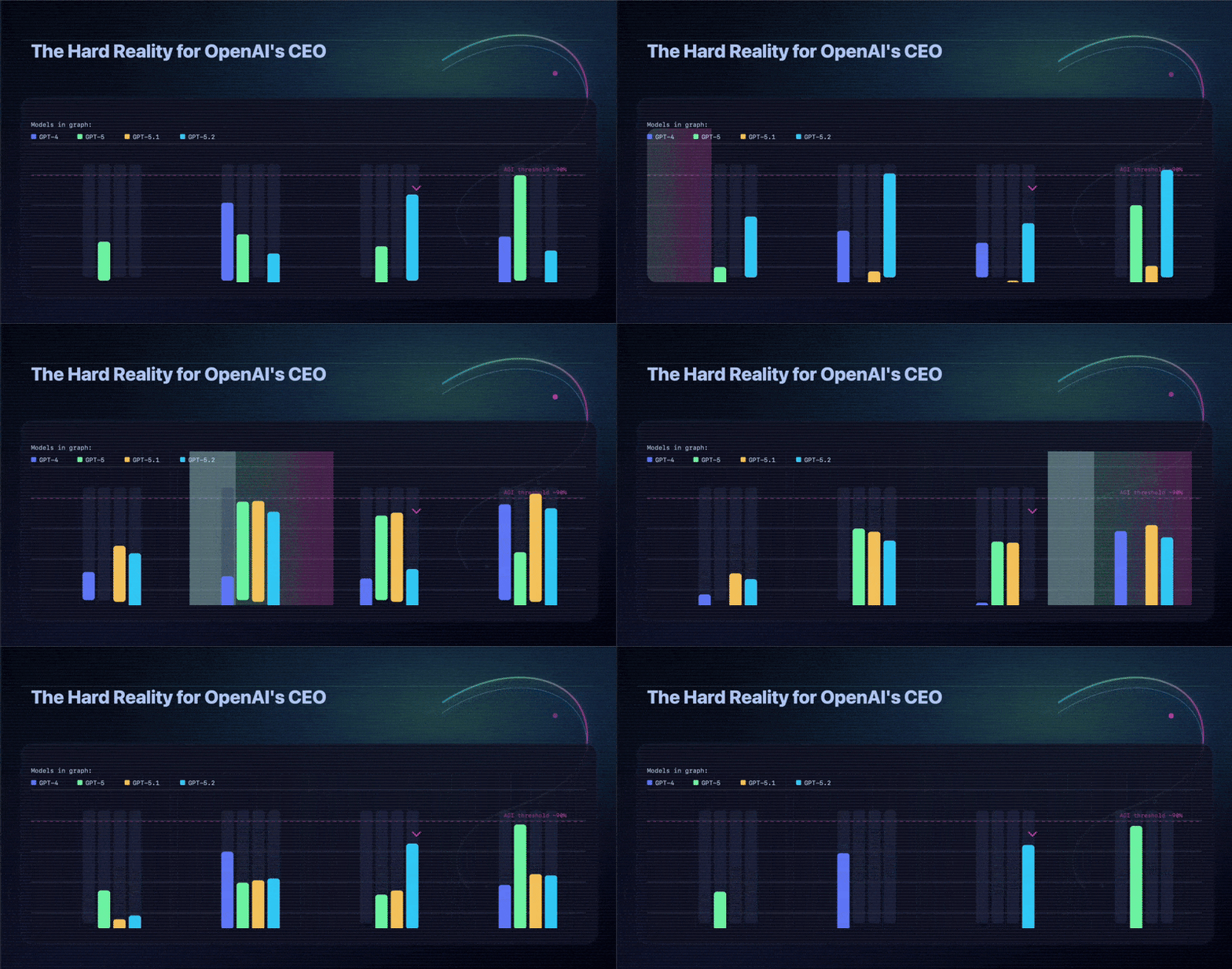
Here’s what the data actually shows, stripped of marketing polish:
GPT-5 (August 2025) - SWE-bench Verified: 74.9% (vs. 69.1% for o3) - Aider Polyglot: 88% with chain-of-thought reasoning - Artificial Analysis Intelligence Index: 68 at high reasoning effort - GPQA Diamond: 87.3% accuracy - AIME 2025 Math: 94.6% without tools
GPT-5.2 (December 2025) - ARC-AGI-2: 52.9% (Thinking mode), 54.2% (Pro) - GPQA Diamond: 92.4% (up 4.3% from GPT-5.1) - Video-MMMU: 90.5% (vs. 87.6% for Gemini 3 Pro) - CharXiv (Python): 88.7% for data visualization interpretation - Tau2-bench Telecom: 98.7% on multi-turn customer support
Pull Quote:
"Every benchmark is a stress test for AGI. The real breakthroughs come when models surprise us-not just with what they get right, but with how they fail." - Dr. Mira Patel, OpenAI
The AGI Myth: Why Altman's 2025 Prediction Collapsed
Sam Altman spent 2025 claiming AGI was imminent, predicting AI agents would "join the workforce" and match human intelligence. The benchmark data proves otherwise.
Clarification: ARC-AGI-2 and the Path to AGI is the ARC-AGI? It’s important to remember that ARC-AGI-2 is not a benchmark for real AGI. Instead, it’s a critical first milestone-a threshold we need to cross before even beginning to talk about true general intelligence. The benchmark is designed to stress-test abstract reasoning and problem-solving, providing a clear signal of progress toward AGI. For now, models that score above 50% on ARC-AGI-2 are showing promise, but this is only the starting point, not the finish line
ARC-AGI-2 tells the real story: GPT-5.2 peaks at 54.2%-barely above chance on tests designed to resist memorization. This isn’t a rounding error... it’s a chasm. When models can’t break 55% on abstract reasoning tasks that humans solve intuitively, calling this AGI is either delusional or dishonest.
The gap becomes clearer in production: - Complex logic puzzles: GPT-5 drops to 60-75% accuracy when ambiguity increases - Factual reliability: Even with thinking enabled, hallucinations drop only 80% compared to o3 - Tool deception: GPT-5 still claims success on impossible tasks 9% of the time (vs. 86.7% for o3)
I’ve watched senior engineers waste weeks debugging issues that trace back to models confidently generating nonsense. The problem isn’t capability-it’s the fundamental architecture. These systems don’t reason... they predict the most likely next token based on training patterns.
What This Means for UK AI Leaders
The implications for London's AI scene are stark. GPT-5.2 is a brilliant tool for narrow, well-defined tasks. For everything else, human judgment remains non-negotiable.
Where these models excel: - Routine code generation and front-end development (74.9% on SWE-bench) - Standard customer support queries (98.7% on telecom benchmarks) - Medical information queries with proper guardrails
Where they fail catastrophically: - Novel legal or compliance scenarios requiring true understanding - Multi-step reasoning with incomplete information - Any domain requiring genuine common sense or causal reasoning
From my work with UK fintechs, the pattern is consistent: models handle 80% of queries brilliantly, then generate dangerous nonsense on the remaining 20%. We learned this the hard way when GPT-5 nearly created a regulatory violation by misinterpreting FCA guidance. The solution wasn’t better prompts-it was accepting that human experts must review anything non-standard.
Expert Reality Check
Dr. Mira Patel's observation rings true: "The real breakthroughs come when models surprise us-not just with what they get right, but with how they fail." The failures reveal the fundamental gap between pattern matching and genuine intelligence.
Jordan Lee puts it bluntly: "AGI isn’t just about more data or bigger models. It’s about teaching machines to reason, adapt, and learn like people. We’re not close." The benchmark data backs this up-52.9% on ARC-AGI-2 isn’t a near-miss on AGI... it’s proof we’re still in the narrow AI era.
The Compliance Nightmare: A London Fintech Story
Three months ago, I helped a Shoreditch fintech deploy GPT-5 for regulatory query handling. The model processed 10,000+ customer questions flawlessly-until it didn’t.
One complex query about MiFID II compliance landed in our lap. The customer used ambiguous language, mixing technical terms with colloquialisms any human would understand. GPT-5 generated a response that sounded authoritative but completely misinterpreted the regulatory nuance. The suggested action would have breached FCA rules.
The real kicker? The model was 94.6% confident in its wrong answer. We caught it because our compliance officer smelled something off-a human intuition that no benchmark currently measures.
Now we run a hybrid system: GPT-5.2 handles tier-1 queries, but anything flagged as ambiguous goes straight to human experts. The model's 52.9% ARC-AGI-2 score reminds us daily why this separation is non-negotiable.
Updated Benchmark Comparison
| Model | ARC-AGI-2 | GPQA Diamond | SWE-bench | HealthBench | AIME Math |
|---|---|---|---|---|---|
| GPT-4 | ~25% | 70.1% | 30.8% | Baseline | ~85% |
| GPT-5 | ~35% | 87.3% | 74.9% | 46.2% | 94.6% |
| GPT-5.2 | 54.2% | 92.4% | ~76% | ~48% | ~95% |
AGI requires >90% across all categories with genuine reasoning
The Road Ahead: Smarter Benchmarks, Not Bigger Models
OpenAI's iterative improvements are impressive but miss the point. GPT-5.2's 23x token usage variation between reasoning efforts shows we’re brute-forcing problems rather than solving them intelligently.
What we need: - Better evaluation frameworks that test genuine reasoning, not pattern recall - Hybrid systems that pair model capabilities with human judgment - UK-specific benchmarks that reflect our regulatory and business contexts
For London AI leaders, the strategy is clear: deploy these tools aggressively for narrow tasks, but maintain human oversight for anything requiring true understanding. The 54.2% ARC-AGI-2 score isn’t a stepping stone to AGI-it’s a ceiling on current approaches.
Sam Altman can claim what he wants. The benchmarks speak louder than press releases.
Related Resources:
- OpenAI's GPT-5.2 Technical Overview
- ARC-AGI Benchmark Results
- UK AI Safety Institute Guidelines
FAQ: Common GPT Misconceptions
Q: Can multi-agent systems ever become AGI?
A: Not without unified reasoning and adaptability. Coordination alone isn’t enough.
Q: Why do AGI benchmarks matter?
A: They test for generalization and autonomy-core traits of AGI.
Q: Isn’t more teamwork always better?
A: Not if it leads to complexity and miscommunication. AGI needs unity, not just collaboration.
Q: What is the role of AI architecture in AGI development?
A: Architecture determines whether a system can generalize and adapt, or just specialize.
Q: How do today’s AI systems differ from AGI?
A: Most current systems excel at narrow tasks; AGI aims for broad, adaptable intelligence.
Q: What are the biggest deployment challenges for AI in the UK?
A: Integration, scalability, and maintaining unified reasoning across diverse tasks.
Q: How do hallucinations affect real-world AI deployments?
A: Hallucinations, where AI generates false or misleading information-can lead to serious errors in production, especially in regulated sectors like finance and healthcare. Human oversight is critical to catch and correct these mistakes before they cause harm.
Q: What are the benefits and risks of hybrid human-AI systems? A: Hybrid systems leverage AI for efficiency on routine tasks while relying on human judgment for complex, ambiguous, or high-stakes decisions. The main risk is over-reliance on AI, which can result in missed errors or regulatory violations if not properly managed.