← All Articles
AdaptiveBridge Unleashed: The Maze of Features — Wasting Money in Production Blitz

AdaptiveBridge Unleashed: The Maze of Features — Wasting Money in Production Blitz

By Netanel Eliav
#MachineLearning #FeatureEngineering #AdaptiveBridge #MLOps #DataScience

Hold on a moment! Even though ML and Data engineers are on the same team, it’s crucial to remember that the customer (and your budget) simply doesn’t care!

In the realm of data-crunching, where astute minds fashion intricate models, the pursuit of the perfect feature set feels akin to a grand expedition. Envision a dedicated ML engineer, armed with algorithms and propelled by both time and money, embarking on a quest to unveil the enchanting features for their predictive model.

This odyssey into feature engineering excellence can become rather expensive, both in terms of monetary expenditure and temporal investment. ML engineers, resembling modern-day wizards, meticulously fine-tune their models, chasing that elusive combination of features that will unravel the secrets concealed within the data.

But here’s the twist — despite all the diligence and resources poured into constructing an extensive feature set, the resultant model is not a sleek and efficient masterpiece. No, it’s a substantial, unwieldy entity, burdened with superfluous features that barely budge the needle on prediction accuracy.

This isn’t merely a theoretical concern; it adversely impacts the functionality of the model. Large models demand more computational power, voraciously consuming CPU and devouring RAM as if it’s going out of fashion. In today’s world, where RAM constraints underpin scaling issues, this poses a genuine problem.


Project Name: AdaptiveBridge
License: MIT License
Documentation: Click Here
Issue Tracker: GitHub Issues


AdaptiveBridge: Feature Importance and Mandatory vs Adaptive
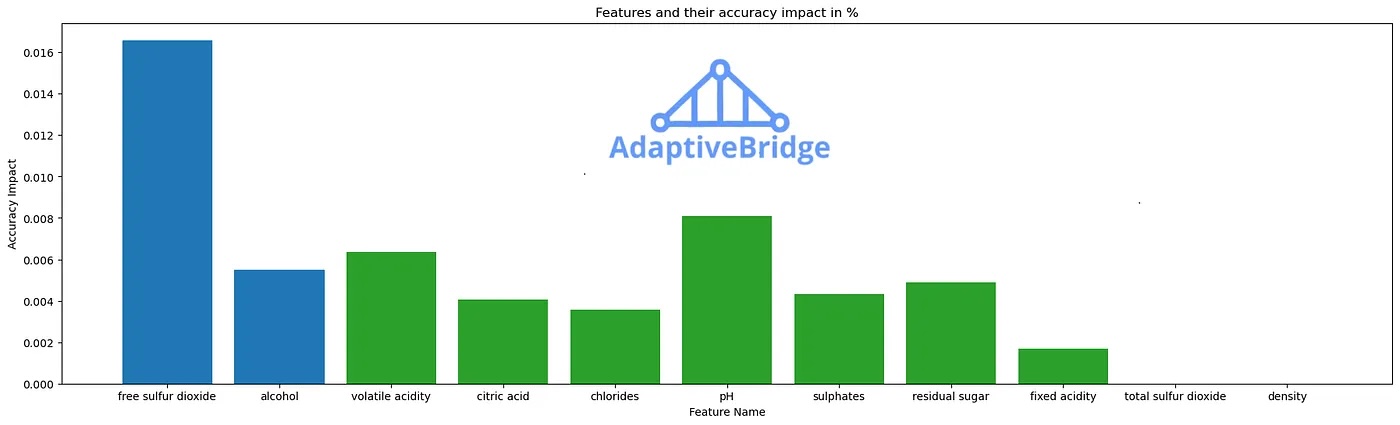
White wine quality prediction: Blue features are mandatory; the rest are nice to have. No need to burden your customers with more than Free Sulfur Dioxide and Alcohol — leverage advanced statistics or AdaptiveBridge for the rest.

AdaptiveBridge, a breath of fresh air in the intricate realm of feature engineering. It daringly challenges the notion that a surplus of features invariably translates to superior predictions. The benchmark results we previously discussed spill the beans — many of those meticulously selected features? Well, as it turns out, they aren’t all that indispensable.

AdaptiveBridge is just an example — the important point is to understand the real-world challenge here.

As our ML engineer navigates the labyrinth of feature importance, AdaptiveBridge unleashes a truth bomb. A multitude of these features contributes minimally to the prediction game, rendering them entirely dispensable. The impact is substantial; the model sheds its excess baggage, evolving into a sleeker, more efficient iteration of itself.

Yet, the narrative doesn’t conclude with the model’s makeover. The handover to data engineers marks a pivotal juncture. A colossal model, brimming with features it truly doesn’t require, could deplete the company’s coffers. The infrastructure and data prerequisites it commands might stretch budgets to their limits and disrupt operational harmony.

AdaptiveBridge: Performance matrix

AdaptiveBridge: Performance Matrix
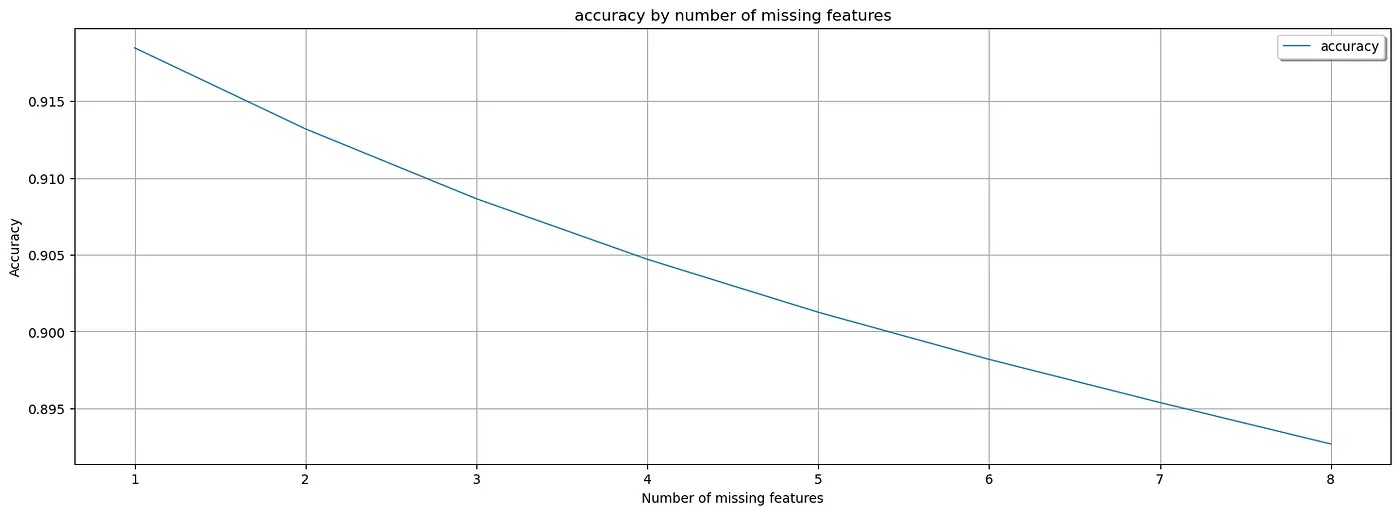
White Wine Quality Prediction: Optimize data requirements without sacrificing accuracy with AdaptiveBridge. AdaptiveBridge Performance Matrix shows the average accuracy for every number of missing features.

Average AdaptiveBridge accuracy with 1 missing features: 91.84%
Average AdaptiveBridge accuracy with 2 missing features: 91.31%
Average AdaptiveBridge accuracy with 3 missing features: 90.86%
Average AdaptiveBridge accuracy with 4 missing features: 90.46%
Average AdaptiveBridge accuracy with 5 missing features: 90.12%
Average AdaptiveBridge accuracy with 6 missing features: 89.81%
Average AdaptiveBridge accuracy with 7 missing features: 89.53%
Average AdaptiveBridge accuracy with 8 missing features: 89.26%

Moreover, customer satisfaction teeters on the edge. If meeting the data requirements becomes a headache, clients might not be overly pleased. In the labyrinth of data crunching, AdaptiveBridge proclaims, “Simplify it!” It demonstrates that a leaner model, honing in on crucial features, not only heightens accuracy but also ensures smooth operations without burning a hole in the pocket.

Consequently, the feature engineering escapade takes a twist with AdaptiveBridge. It overturns the notion that complexity equates to accuracy and signals a future where simplicity reigns supreme. The saga of the ML engineer’s adventurous journey, previously burdened by redundant features, concludes with the revelation that simplicity, infused with a touch of AdaptiveBridge magic, unlocks the true potential of data crunching.

FAQ

Why do big feature sets increase production cost?
Large feature sets increase production costs through multiple channels: data collection and storage infrastructure scales linearly with feature count, pipeline complexity grows exponentially requiring more engineering resources, and inference workloads consume significantly more CPU and RAM. In production environments, these costs compound across millions of predictions, turning a model with 50 features into a budget-draining liability compared to a lean 5-feature alternative that delivers similar accuracy.
Does reducing features always hurt accuracy?
No—many features contribute marginal value to model performance. Research shows that focusing on the top 10-20% of most predictive features often maintains 95%+ of the original accuracy while dramatically simplifying data requirements. The key is identifying which features drive predictions versus those that merely add noise. Feature importance analysis reveals that some features improve accuracy by less than 0.1%, making them prime candidates for removal without sacrificing model quality.
What problem does AdaptiveBridge solve?
AdaptiveBridge addresses the critical challenge of missing features in production environments. Traditional models fail or require full feature availability at inference time, but real-world data is often incomplete. AdaptiveBridge enables models to adapt dynamically when features are unavailable, maintaining robust predictions even when 20-50% of expected features are missing. This resilience reduces data collection requirements and keeps models operational when upstream data sources fail or are costly to maintain.
What is feature engineering and why does it matter?
Feature engineering is the process of selecting, creating, and transforming raw data into inputs that machine learning models can effectively use for predictions. It matters because well-engineered features often determine model success more than algorithm choice—a simple model with great features typically outperforms a complex model with poor features. However, over-engineering features leads to bloated models that are expensive to maintain and deploy in production environments.
How many features should a production ML model have?
Production ML models should prioritize feature efficiency over quantity. While there's no universal number, best practices suggest starting with 5-15 highly predictive features for most business applications. Models exceeding 50 features often contain redundant or low-value inputs that increase costs without meaningful accuracy gains. The optimal count depends on your specific use case, but lean feature sets (under 20) typically offer the best balance of accuracy, cost, and operational simplicity.
What is the cost difference between a 50-feature and 10-feature model?
A 50-feature model can cost 3-10x more than a 10-feature model in production. Data storage scales linearly (5x more features = 5x storage), but pipeline complexity grows exponentially—more ETL jobs, data quality checks, and monitoring. Inference costs increase through higher CPU/RAM requirements per prediction. For systems processing millions of predictions daily, a bloated feature set can mean the difference between a $5,000/month infrastructure bill and a $50,000/month bill, while often delivering only marginally better accuracy.
How do you identify unnecessary features in a machine learning model?
Identify unnecessary features through systematic feature importance analysis: 1) Use built-in importance metrics (random forest feature importance, SHAP values, or permutation importance), 2) Remove features with importance scores below a threshold (e.g., <1% contribution), 3) Test model performance after removing suspected low-value features, 4) Analyze correlation matrices to find redundant features, 5) Conduct ablation studies where you remove features incrementally. Tools like AdaptiveBridge can automate this process by testing model robustness across different feature combinations.
What happens when features are missing at inference time?
Traditional models typically fail when expected features are missing at inference time, throwing errors or returning null predictions. This creates operational fragility—if an upstream data source breaks or a feature becomes unavailable, the entire prediction pipeline stops. Organizations often resort to expensive workarounds like maintaining complex imputation logic, building redundant data pipelines, or requiring all features even when some are difficult or costly to obtain. This is the exact problem AdaptiveBridge addresses through adaptive feature handling.
Can you use AdaptiveBridge with any machine learning algorithm?
AdaptiveBridge integrates with tree-based models like Random Forest, XGBoost, and LightGBM, as well as neural networks and ensemble methods. The library provides wrapper classes that intercept feature inputs before they reach your model, enabling adaptive handling of missing data. Integration typically requires 5-10 lines of code to wrap your existing model. For complete integration examples and framework-specific code samples, visit the project documentation at inetanel.github.io/adaptivebridge.
What is the performance impact of using AdaptiveBridge?
AdaptiveBridge performance data shows minimal accuracy degradation even with significant feature absence: with 1-2 missing features, accuracy remains above 91%, and even with 8 missing features, the model maintains ~89% accuracy compared to the full-feature baseline. This graceful degradation means you can optimize data requirements without catastrophic accuracy loss. The trade-off becomes a business decision: is a 2-3% accuracy drop worth a 50% reduction in data collection costs?
How does AdaptiveBridge compare to traditional feature imputation methods?
Unlike traditional imputation (filling missing values with mean/median/mode), AdaptiveBridge doesn't require knowing feature values at all—it adapts the model's decision-making process when features are genuinely unavailable. Traditional imputation assumes you can collect the data but it arrived incomplete, while AdaptiveBridge assumes you may never collect certain features. This makes AdaptiveBridge superior for reducing data requirements by design, not just handling occasional missing values. It shifts from 'fix missing data' to 'build models that don't need all data.'
What ROI can companies expect from optimizing feature sets?
Companies optimizing feature sets with approaches like AdaptiveBridge can typically achieve 40-60% reduction in data infrastructure costs, 30-50% faster model deployment cycles (fewer features = simpler pipelines), and improved customer satisfaction through reduced data collection friction. Real-world examples show organizations cutting model inference costs from $50K to $20K monthly while maintaining 95%+ of original accuracy. The ROI compounds over time as leaner models require less maintenance, monitoring, and engineering resources compared to feature-heavy alternatives.
← All Articles